
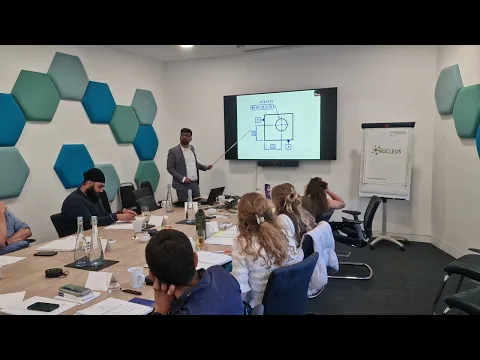
Advanced Course
GD&T to ASME Y14.5 – Advanced
An intensive two-day course in GD&T, which follows on from, and builds upon, the Fundamentals course.
Course Overview
Build Advanced ASME Skills
This intensive two-day course develops the more advanced concepts of GD&T to the ASME Y14.5 standard. Participants expand their understanding of datums, material condition modifiers, tolerance interactions, and the deeper rules that govern ASME Y14.5.
The course focuses on advanced interpretation and correct application of the standards, with worked examples throughout and opportunities to discuss industry-specific scenarios.
Learning Outcomes
What Participants Will Gain
By completing this course, participants reinforce core concepts from the Fundamentals course and extend them into more advanced areas of ASME Y14.5.
Build on Fundamentals
Reinforce core concepts from the Fundamentals course and extend them into more advanced areas of ASME Y14.5.
Master Datum Structures
Learn how to define datums using complex surfaces, groups of features, contacting features, and situation features.
Use MMC and LMC
Apply Maximum Material Condition and Least Material Condition correctly, including datum shift, bonus tolerance, and virtual condition boundaries.
Interpret Complex Drawings
Apply rules for non-rigid parts, projected tolerance zones, multiple feature controls, and grouped tolerances with confidence.
Gain Practical Confidence
Work on practical exercises with real drawings and parts to gain hands on practical experience.
Apply Standards Correctly
Strengthen advanced interpretation and correct application of ASME Y14.5 in real engineering contexts.
Course Details
Who It Is For
This course is designed for individuals who have completed the Fundamentals course and require a deeper, more technical understanding of ASME Y14.5.
Ideal Participants
Design and Mechanical Engineers, Inspectors and Inspection Planners, Drafters, and Machinists, Operators, and Tooling Engineers.
Wider Team Value
Also valuable for Sales, Purchasing, and Quality personnel, Managers, Supervisors, and Production Associates.
Entry Requirement
Completion of the Fundamentals course is required. Participants are welcome to supply drawings or components, which may be integrated into exercises to enhance course applicability.
Delivery and Class Size
Onsite or online delivery. Delegates don’t need to bring materials, laptops etc. All materials are provided by GD&T Academy. An upper limit of 10 delegates is advised to ensure effective learning.
Syllabus
Advanced Topics Covered
The syllabus builds from Fundamentals into deeper ASME Y14.5 application, interpretation, and control strategy.
Datums and Features
Review of the Fundamentals course material, guidelines for working with geometric tolerances, the six-step method, ideal and non-ideal features, datums, situation features, common datums, complex surfaces, contacting features, moving datum targets, and controlling individual degrees of freedom.
Material Conditions
Maximum Material Requirement, review of Maximum Material Condition modifier applied to tolerance values, bonus tolerance, virtual condition boundaries, zero tolerances at MMC, Least Material Requirement, and Maximum Material Requirement applied to datums including datum shift.
Tolerance Zones
Datums based on virtual condition boundaries, projected tolerance zones, and tolerances applied to non-rigid components.
Complex Controls
Multiple and composite tolerances applied to groups of features, FRTZF and PLTZF, different ways of controlling patterns or groups of features, and multiple and composite tolerances applied to surfaces.
What’s Included
Materials and Delivery
Detailed course notes including drawing examples, workbook with exercises and other printable handouts, quizzes and knowledge checks to gauge progress throughout the course, and a certificate of course completion.
Delegates don’t need to bring materials, laptops etc. All materials are provided by GD&T Academy. Participants are welcome to supply drawings or components, which may be integrated into exercises to enhance course applicability.
GD&T Academy delivers this advanced training onsite or online, always focused on practical application and confident use of ASME Y14.5.